Wednesday, 15 May 2013

Battle of the Gods Typography

For Battle of the Gods I wanted a font that suited the theme, so I decided to design my own. I knew that the text would be laser etched, in which case it would need serifs (based on my knowledge of the way Romans carved their letters into stone), so I started by taking some good fonts and adding demonic style serifs, because I thought they'd look cool.


 Kari Display Pro plus spiky serifs

 Futura Black with curly serifs

Helvetica Black with spiky curly serifs

I realised that if I'm laser etching this it will be quite thick, which would make it expensive. So I looked into another style of text I like, Blackletter, because it's a lot thinner and I thought that the intricacies of it would come out nicely etched into wood.


It looks cool, but it just says medieval, it doesn't say Fantasy wargame. To make up for where I was missing I looked at some wargame fonts, I checked out:


I tried to write my game font in the same style as these, with varying successes:


I decided that due to the size constraints I would be better off with 2 layers than 1 single line of text, and I was inspired by the font Alchemy to have letters that were a bit bizarre looking.


I realised that due to the nature of the laser etcher I was better off with just outlining the text, which meant that the outline had to be pretty cool, with some overlapping underlapping shit. That was how I settled on this style of B.


Now that I had these overlapping spikes I designed the rest of the text with this in mind. Because it's a display heading I really just considered how each letter would look in the word it was part of, considering it as a whole image. 

 With this I decided that a smaller O was good and a snake like S (like my dragon) and the Bone style serifs I had for the letter B carried over to the D.

I spent a long while trying to figure out how the G and O linked into each other. I wanted to the decorative serifs to lead into one another, and for the finished thing to look a bit mental.


Which all lead me to this finalised version:

My dad's always saying that beauty is about how symmetrical you are, so I tried to make my title text symmetrical. so the S and G both have parts that curl down and towards the centre, and the B and the L + E mirror each other. I slotted the "of the" part in the middle, which I'd decided on by seeing how the curly Fs I like to draw could link up with a much simplified version of the O I used in "GoDS"and then writing "the" so it matched. I think it managed to combine the madness of the Mordehiem title with the sleeker look of the Warmachine title. AND most importantly it focusses on the line rather than the fill, which is what the Laser Etcher is all about.

After that I use the website myscriptfont.com to create a font out of what I'd designed for the display text. I simplified it somewhat and got this:


The end result doesn't really work at small sizes because the lines are so thin. I tried using it to write everything but the response was it was too difficult to read, so I only used it for headings and just used the same text they use for Warhammer source books for my body text, Garamond. The good thing though was I was able to make some symbols for use within the game, such as Energy and Damage, these extra characters were the £ and € symbols in my font. So whilst it was mostly written in an already existing font my display font allowed me to personalise the titles and add symbols into the text easily.

Tuesday, 14 May 2013

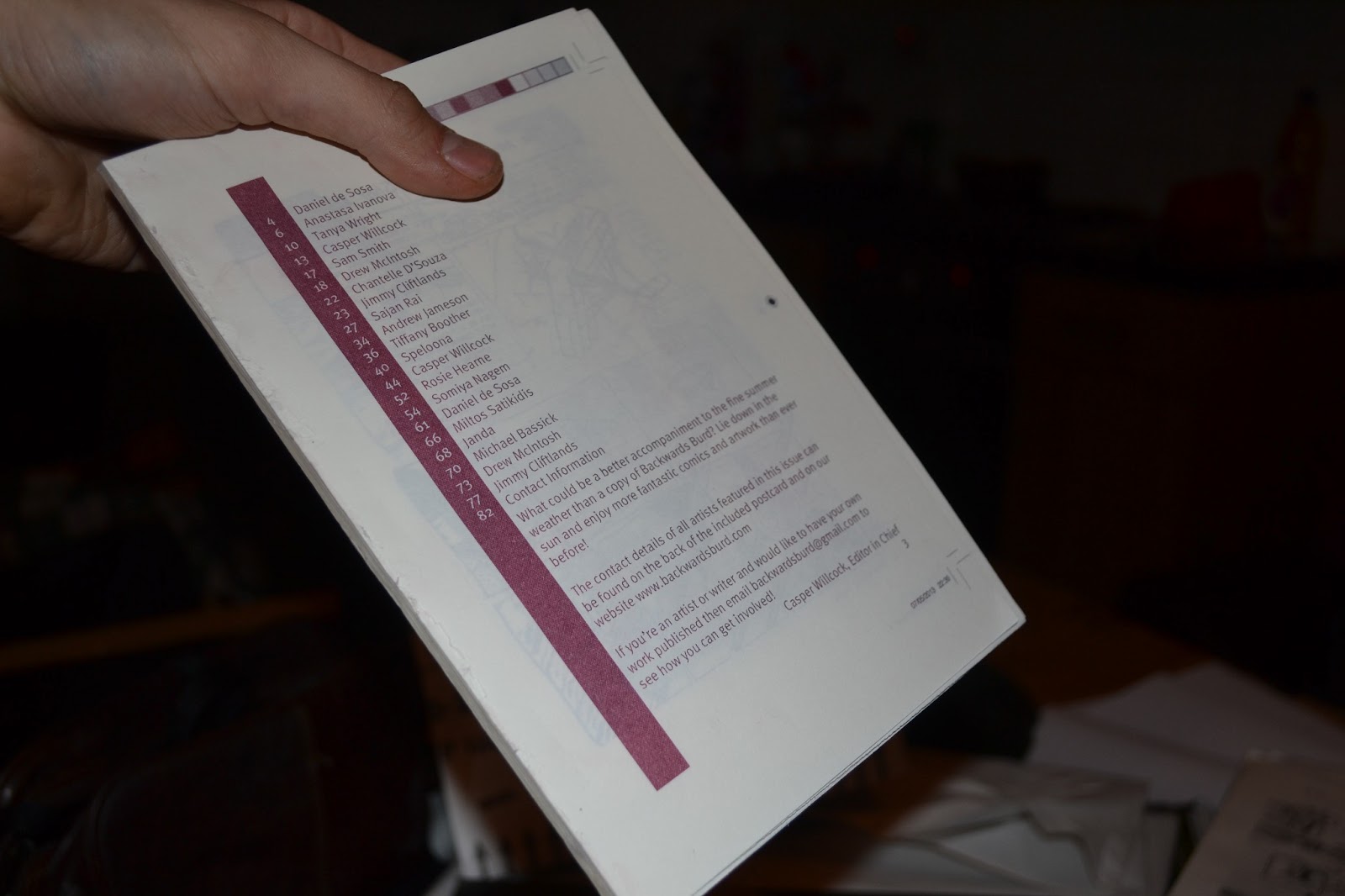
Backwards Burd Anthology 3

After the success of Anthology 2 we had a lot more good students submit their artwork, which allowed us to really pick and choose good content for the magazine, and still have around double the page count.

The risograph printer is now also available to us, which allows us to print the magazine at a much reduced cost. We started the project a lot sooner after online issue 6 than we did Anthology 2 after issue 4, which has definitely given us more breathing space, however it still feels very claustrophobic.

Because we were printing it ourselves I needed to paginate the magazine first, which was a new skill to learn, and which I've since taught to everyone else! I was really struggling to figure it out, searching google and getting dodgy looking softwares as a result, I was getting pretty stressed out trying to figure it out when American Dan suggested I call Dittopress and ask them. My first thought was I don't think they'd want to help me do that, it's sort of taking business away from them. But I was still stressed and no further ahead, so I called them and the girl on the phone was really helpful. She explained the whole process clearly enough for me to understand without being physically shown. I'm still very appreciative to them for being so helpful!

I thought there'd just be a button on indesign I could press, but it turns out you need to make a dummy book, unfold it, make your pages according to how they match up on the dummy book sheets, export them as spreads, drag these spreads into A3 size document, flipping horizontally and vertically the top spread (I make books at A5 because any bigger is beyond my price range). I made my Grug the Destroyer comic book first before attempting Backwards Burd, so any mistakes I made were with my own work, not the Burd's.

We folded the amount of sheets required for the new issue (10) and realised it was too thick to be saddle stitched (saddle stitched is right for 30-40 pages I'd say) and we had 80, so we did some research.

I considered japanese style binding, but I don't think the look is right for Backwards Burd. It seemed too delicate/intricate for us, I wanted something that said traditional comic more. For now we have settled on perfect binding, which is probably called thus because you have to get everything perfect for it to work.

The printing process was gruelling. Because the risograph is in the tutors office once you're in there working you can't leave, because if you do you might not be able to get back in again, or I just felt like I was being annoying enough, without getting the tutors to get up and let me in more. With that in mind I just worked as quickly and solidly as I could, and a few hours later over a 1000 sheets had been printed on both sides.

We also got the covers done, we did them 2 colour, burgundy and red. This worked really well, even though sometimes it moved around quite a bit registration wise, they still look really cool.

Then the hard part, putting them together. I went to BnQ to get the parts to make a book making press inspired by this video:


I think this probably isn't the best way to do things, but it works for the most part. We found that the books we made weren't sticking together when we opened them out fully. This was because the spine wsa drying all wibbly-wobbly from the wetness of the glue. So Dan figured out a good solution, we glue the edge, then use 2 of our metal rulers, one above the spine edge, one below, and then clamp them in place. This way the spine stays straight and slots into the cover much more easily. Once it's had a few coats like this we fold the cover so that it has a 5mm spine, load that 5mm wide space up with book binding glue and slot the block of inside pages in. After that we guillotine it on the side, bottom and then the top, and tadah, a copy of Backwards Burd! only 99 left to go...


These clips are really useful when making books.


Here are 5 finished copies with their sleeves on and postcards inside, I didn't take much role in the screen printing side of things this time, has I was just focussing on printing the pages. I think it looks great, we sold 2 for £10 each so far! We've a few made up so far, but our aim is to have plenty more made to sell at MCM. My dream is to do well enough to be able to pay ourselves for making them, but I don't know how possible that is, but it's more possible when they look this cool than it's ever been before.

Friday, 10 May 2013

Altered Book Illustration Project

For this project we were required to alter a book in a sculptural sort of way. Off the back of the last project I felt that the best way to do this now was just try lots of different things until I find something I like the idea of. With that in mind I went to the charity shops in and on the walk to East Ham from my house in Plaistow and bought a few books were ideas popped out at me straight away.

I bought a book on John Wayne and cut it in such a way that a few of the pages stood up and made a 3d shape of John Wayne shooting someone in a duel. It was very flimsy and just kept flopping over, so I left that idea alone.

I bought an illustrated old testament which was quite a nice book and started defacing it because I thought it was cool F U to religion  but it looked shitty and I felt that I was being no better than those religious nut cases stood on street corners shouting about how God's really gonna save you. So I stopped doing this idea as well.

I also bought a book called City of Bones, I tried to glue all the pages together and then cut it into a city map like New York City but all the buildings were bone shaped and the island was bone shaped. However glueing each of the pages with PVA to one another just turned the book into an unmaleable pulp that was difficult to work with, so I also scrapped that idea.

What I did like about the City of Bones idea though was making a map within the pages of a book, with this in mind it dawned on me I should cut up the Lord of the Rings trilogy to represent a map of the world, as Tolkien was mad for maps as well he made a lot for me to reference, and it seems like a good homage to the story/journey.

I was met with a lot of flack from my flatmate Dan and friend Anastasia, they couldn't believe I'd bought a nice new set of LOTR books to cut up, but I figure that if I cut up something that I care about I'll try to do a better job and just make a more informed piece.

I used cut nets out of the pages and stuck them together to form models of the iconic buildings. With the mountains I was trying to do them like 3D contour lines but when I was doing Mount Doom I realised I should have done all of the mountains like that instead. The tree leaves are made by sticking a lot of irregularly cut pages together.

The whole process was very fiddly and uncomfortable, the glue I used was very strong and kept getting on my fingers as I was making such tiny models, and then the models would stick and so I'd have to cut bits off of my fingers, sometimes with bits of my finger still stuck to the model.

 From the journeys beginning into the darkness.

 The Fellowship of the Ring

Birds eye view of the Fellowship of the Ring 

Minis Tirrith and Osgiliath 

The White tower of Isengard and Fangorn Forest 

Lothlorien Forest and the entrance to the Mines of Moria 

The Return of the King birds eye view 

The Two Towers birds eye view 

 The Two Towers

The view of Rivendell from Weathertop

The response to these photographs has been that I need to get better at photography, so next time I photograph my work I will use a tripod, get in some better lights and set the camera to a slower shutter speed.

I have curated these books as well as my some of my class mates within the display cabinet at the front of our illustration class room, where people who feel my photography is lacking can see the real things.

I don't think I would make this sort of art again, it is very difficult for a result that does not look worth the amount of time it takes, but it was fun to look up all the Lord of the Rings history and background again.

Tuesday, 7 May 2013

Printing Grug the Destroyer

To go from not creating any comic book ever to a full 28 page story feels like a hell of an achievement. I printed Grug the Destroyer on paper I sourced specially from GF smith and printed it on a risograph, which gets across the comic book feel quite well.

I learnt how to paginate the book correctly by calling Ditto Press and asking them, unfortunately there isn't just a button I can press on indesign, and the process is quite lengthy because you have to check everything is right at each stage or else your printed book will not work when assembled. After learning how do to this I taught the rest of my class that wanted to print and bind their own comics. Some other students joked that I was running workshops, but I like teaching people. I wouldn't want to be a teacher right away, but when I'm older and more experienced I think it would be quite fulfilling.

Despite understanding the process enough to teach others I managed to get it wrong myself and wasted 50 sheets worth of good A3 paper, thankfully it was easy to rectify the problem but because I hadn't noticed it straight away I ended up wasting money. From then on I ensured all of the people I helped were extra careful when printing their books, as sloppiness leads to sloppy end products.

I have bound a couple (not all as I have not had time/access to the guillotine to make the process much faster) and I think they look great. I did a 2 colour cover, originally intended to be black and blue but the blue ink ran out, so instead I used green (which sort of goes with Grug's title anyway). The cover depicts Grug staring at his reflection and seeing the wicked transformation he will become if he does not leave the path of merciless destruction. The back cover shows the armour at the bottom of the sea, which is where Grugson chucks it at the end of story. I like the idea that the reader will pick the book up, look at the back and front, then after they have read the story they look at the cover again and see it for what it really is.

I know that my strengths don't lie in making comics so much, but I do have a good eye for semiotics and writing I think, so I will continue to improve my drawings and hopefully one day the end result will be really good, for now though I think it's pretty impressive. I'm going to try selling them at MCM alongside Backwards Burd Anthologys, I think after that I'll realise how successful a venture they have been.

Monday, 6 May 2013

Battle of the Gods, the final illustration outcome!

The illustration side of my Battle of the Gods project is more centred on the characters and story that I'm trying to tell through my game. With this in mind I decided to make a booklet with artwork, stories and the rules for the game.

This is largely inspired by the source books that I used to pour over when I played Warhammer a lot as well as by the source books from the newer game I play called Infinity. The art style was much more similar to the Warhammer books, but I preferred the way the Infinity books are laid out with the stories at the beginning and then the rules at the back, with comics and character art throughout.

My original plan was to use the vector drawings I'd done as the character art, but when I tried it they looked out of place besides the hand drawn comics, so I redrew them in pen and then they looked much better.

For the comics I tried to get across humorous interactions between characters, shows of strength or in the case of Fire Bat just a little insight into the characters day to day life. It was a refreshing change to draw shorter 3-5 panel comic strips compared to my larger format Grug comic, but I was able to use everything I've learnt from doing Grug to make these comic strips interesting to look at.

The typeface I used was Carlson Antique because it is the one that Warhammer source books use, I tried making my own but due to its decorativeness I could only use it for the headings.

When it came to making the booklet I used what I have learnt from editing Backwards Burd and printing Grug to paginate the book correctly and then print it on a risograph printer on paper I had sourced specially from GF smith. The cover used a full colour painting though so I printed it at Service Point using their laser printer on 160gsm paper. Then I bound it together by hand. I made 3, the last one being the best bound. Because the inside pages were printed on a risograph the registration between the front and back of the pages was a little off, but because I use large inside margins this was not too great a concern.

The final outcome really looks like a wargame source book, so I'm very happy with it. I would have liked to have printed it on an indigo press but the cost was too prohibitive considering how few copies of the book I actually need, but if I were to pursue Battle of the Gods as a commercial enterprise I would print it more reguarly than it was on a risograph.


Wednesday, 1 May 2013

Grug parts 5 and 6

The final 2 chapters of Grug the Destroyer bring the story to a close and allowed me to try out some techniques I hadn't been confident enough to do before.

In part 5 I took the idea of the girl (now grown old) narrating over the top of an action scene, and applied it to Grugson's training which was all about movement, so I tried some panels were the character ran through a scene that was split up (running across the log and jumping down) and looked into motion lines. I also paid closer attention to the verbal language of comics so that I could depict the now elderly girl being ill, it turns out that in comics characters "KOFF" rather than cough. In part 5 I didn't use any arbitrary lines running across the page, instead sticking to 1 or 2 drawings with panels inside that depicted other actions, which makes it look a lot more interesting as it's like there's layers of information for the reader to look over rather than a flat 1, 2, 3, 4 way of teling the story. Another little visual language thing I liked about part 5 was when the girl dies her speech bubble trails off instead of being closed, to represent her last breath fading away.

For part 6 I attempted something I had previously not been confident enough to do, and that's blacking large sections of the comic out. It worked well with the grimmer nature of the stories end, as Grugson confronts the transformed all powerful and now completely evil Grug. I allowed myself for the first time to use a brush to ink rather than my dip ink pen, which meant I got solid fill rather than cross hatching. I think this worked really well, and after Grug turns the evil armour on itself and it loses its malevolent power the darkness shrinks back, showing how the world the characters inhabit is opening up from the oppression and depression it had been under.

I also really enjoyed looking at the difference in drawing ability from the first couple issues of Grug compared to the last one, in order to capitalise on this and bring the story around full circle I redrew panels from the first and 2nd issue, namely the drawing of the girl holding her hand up to protect herself and also I drew the transformed Grug in the same pose. At this point in the story Grug realises that he is about to watch his son be killed and manages to wrestle control from the armour. I wanted to create a sense of flash back so I literally reused the poses and drawings to put the same idea in the audiences' mind.

The final page of Grug the Destroyer shows a dawn rising at the coast, whilst a girl with a baby peer out from behind a rock, to show that the world is beginning anew and that it is safe for the vulnerable. I also kept in mind though that I could pick the story back up later by saying that the girl with her baby in fact was not peering out wondering if the world is safe now, but rather she is the only person to see what happened to the evil armour, and perhaps her son will become the next Destroyer.

I really enjoyed trying to tell a story across a 28 page format, doing 4 pages per month (8 for the last one) really allowed me to absorb criticism and advice and search for better ways of doing things. Most of my projects are left alone after a months work, but to go back each month meant I could really track the progression I made. I will continue to make comics, I made a lot of little baby steps with Grug but I look forward to beginning my next story higher up the ladder.